Photo: Roy Zuo / Wikimedia Commons, CC BY-SA 4.0.
On November 23rd, 1995, the then-president of the Federal Republic of Germany Roman Herzog stood before a local police academy band in Porto Alegre as part of a state visit to Brazil. In a customary fashion, the band played what was expected to be the national anthem of the recently unified Federal Republic. Instead, they played “Auferstanden aus Ruinen”, the national anthem of the German Democratic Republic (GDR), which had ceased to exist a little over five years before.[1]
The German Democratic Republic came to an end on October 3rd, 1990 when its accession to the Federal Republic of Germany took effect under the Unification Treaty. The Treaty on the Final Settlement with Respect to Germany, signed in the previous month by the two German states and the four victorious powers of the Second World War, had at last resolved the external questions that had remained from the division of Germany and cleared the international path for unification.[2] Having existed for over forty years at the forefront of a hypothetical confrontation between the former allies of the Second World War, the end of the GDR was part of the gradual disintegration of the Second World amidst the revolutionary wave that had swept the once firmly Soviet-controlled socialist states.[3]
Mired in controversy during its existence and certainly after reunification, the GDR is chiefly remembered by the world for having at its disposal one of the most extensive and repressive apparatuses of mass surveillance in the 20th century. By 1989, the Ministry of State Security (colloquially known as the “Stasi”) employed over 91,000 full-time personnel to maintain an iron grip over nearly every aspect of public and private life.[4] The political order, dominated by the Socialist Unity Party (SED) through the National Front, had never been legitimized through free and fair elections.[5] The dependence on Soviet power for the survival of the state had already become evident by June 17th, 1953 when the Group of Soviet Occupation Forces in Germany was called upon to crush an uprising against one-party rule and deteriorating economic conditions, having initially begun as a grievance over increased work quotas.[6]
Yet, such experiences were only part of life within the so-called “antifascist state.” Despite periodic shortages of consumer goods that were common to the other socialist states, the GDR maintained a comparatively favorable standard of living by the early 1980s. Between 1970 and 1980, the state had attained the highest living standards among the member states of the Council for Mutual Economic Assistance (COMECON).[7] The ownership of durable consumer goods such as automobiles, washing machines, refrigerators and televisions was modestly high when compared even to the colossal economy of the Soviet Union.[8] Of course, such achievements were not without problems that plagued the country until its end. The GDR suffered from a massive brain drain due to emigration of qualified workers before the construction of the Berlin Wall in 1961 while the population suffered from limited consumer choices, long waiting periods for a wide range of consumer goods and a restricted freedom of movement.[9]
How, then, did such a dynamic and controversial period of German history become the backbone of today’s contradictions in the territory of the former GDR? Ultimately, the disappearance of the German Democratic Republic did not result in the disappearance of over forty years of social expectations, collective memories and political dispositions. The legacy has instead fragmented. Loyalty to the socialist system remains disproportionately, though not entirely, associated with modern left-wing movements within parties such as Die Linke, while significant portions of the former East German population have proven to be open to the far-right Alternative für Deutschland (AfD).[10] As such, the political aftermath of the GDR cannot simply be reduced to a transition from socialism to far-right sentiment. What instead transpired is far more complex. Memories of social security, predictability, cultural cohesion, a national identity and social familiarity persisted alongside the experiences of political and economic disruption after 1990. This transition, connected to reunification itself, transformed those memories into experiences of loss and misrecognition. The AfD subsequently proved to be adept at separating those legacies from their socialist ideological origins and reconstructing them around nativism, anti-elitism, regional identity and opposition to the post-1990 political order.[11]
It is worth examining perceived social security in the GDR as one of the foundations of the post-reunification political scene. As late as the era of Erich Honecker, economic problems did not impede the development of the Einheit von Wirtschafts- und Sozialpolitik (Unity of Economic and Social Policy) as a mechanism for increasing public satisfaction, the components of which included an increase in pensions, extended paid maternity leave, extensive childcare and subsidized housing. These measures were conducive to rather high labor participation, providing a sense of economic security at the cost of growing debt and resource consumption for the planned economy.[12] For example, by 1988, kindergarten provision covered approximately 94% of the corresponding age group and basic rents were low by German standards, ranging from 0.80 to 1.25 East German marks per square meter.[13] The Freie Deutsche Jugend (FDJ) youth organization, through high membership rates unofficially enforced by institutional pressure, provided various recreational activity opportunities for members.[14] Nostalgia for these elements demonstrates a longing for real or perceived stability, which is not synonymous with positive memories of rule under the SED. Later research began to highlight an important contrast: that of memories of the social order of the era and memories of the political system, the former of which is much more positive than the latter. Positive memories of the GDR, as per such analysis, do not necessarily imply a wish to return to the political system and one-party rule but rather the cohesion that, strangely enough, this system had created in a bid to legitimize its existence. The dominance of state institutions in cultural and public life whereby education, employment, housing and retirement were rigidly organized created an atmosphere of predictability that, when evaluated against rapid changes of the 1990s, remains as an important political element in the present day.[15]
Much like many of the other former socialist states that were transitioning from central planning to a market economy, the former GDR had experienced a period of economic downturn in the early 1990s that reinforced a marked legacy of disruption to the previously mentioned social structures. Informally known as the Treuhand, the Treuhandanstalt (“Trust Agency”) was originally established by the GDR several months before reunification to organize and convert state-owned enterprises into legal forms that would be compatible with a market economy. The Volkskammer passed the Treuhand Law on June 17th, 1990, which paved the way for the rapid privatization of these enterprises.[16] At the time of the law’s entry into force on July 1st, 1990, approximately 4.1 million workers were employed by such enterprises. By 1994, only about 1.5 million jobs remained in privatized successor enterprises, with over 3700 enterprises or their components having been closed. Despite the radical transition, it would be a mistake to interpret the privatization process as a deliberately malicious action. Currency conversion and exposure to the world market made many of the state enterprises simply uncompetitive, with approximately 7600 of such entities being threatened by insolvency following the monetary union.[17] The effects on the former GDR, however, were undoubtedly severe and often interpreted through the lens of a loss of recognition and stable economic prospects. Kim Leonie Kellermann’s 2024 study, published in the Journal of Comparative Economics, found for example that former citizens of the GDR who lost employment through the Treuhand restructuring were more likely to demonstrate lower interpersonal trust and decreased identification with the mainstream democratic parties, connecting to a greater preference for radical parties. These effects remained present for up to thirty years and, arguably, maintain their relevance. Kellermann further interprets the political alienation felt by former East German citizens as consistent with nostalgia for a system that once provided more social security.[18] An interesting consequence of the economic transformation is the question of whether former careers and skills that were acquired in the GDR retained their relevance or were disregarded during the period of transformation. Such dilemmas subsequently became part of the backbone for the continued perception of some former citizens of the GDR as being “second-class” citizens in spite of their contributions to the rebuilding of eastern Germany after reunification.[19]
The 2023 Sachsen-Monitor reported that approximately 60% of respondents said that East Germans were treated as Bürger zweiter Klasse (“second-class citizens”). Yet, the same report showed that 86% of respondents agreed that inhabitants of Saxony could be proud of what has been achieved since 1990, with approximately 60% of the respondents agreeing with the idea that the GDR was an Unrechtsstaat (“unjust state”).[20] An interesting study presented by the Sächsische Längsschnittstudie tracked a cohort born in 1973, which showed that across surveys from 2000 to 2012, between 80% and 92% of them said that they were glad for having “personally experienced” the GDR. Simultaneously, however, support for German reunification itself rose from 73% in 1990 to 91% by 2013.[21] Given this information and considering the popularity of far-right and far-left elements in eastern Germany, how can positive notions of the GDR and the idea of unequal treatment and injustices coexist with a positive view of the post-1990 development? Here lies a peculiar paradox that undermines two simplistic interpretations: that reunification itself was largely rejected and that the end of the GDR brought temporary but manageable disruptions that were otherwise eclipsed by the benefits of a unified Germany. In reality, individual satisfaction and collective grievance can be present at the same time. A positive biography of life in the GDR does not have to be mutually exclusive with condemnation of the regime and approval of reunification. What appears to have occurred is that the spirit of Ostalgie did not become synonymous with a unified movement that promotes the old regime and vouches for its rehabilitation. Instead, nostalgia itself has become an assortment of selected aspects that, when taken in isolation, become instruments of grievance against the current German state and therefore, a basis for populist movements in the eastern regions.[22]
An interesting and often overlooked example of “biographical devaluation” is the fate of personnel of the Nationale Volksarmee (NVA), the armed forces of the GDR, at the time of reunification. During dissolution, the NVA was composed of approximately 89,000 to 93,000 personnel. Of those who sought to continue their service under the Bundeswehr, only a minority (10,800 out of 26,000) were retained.[23] Furthermore, their integration meant that former NVA personnel often did not maintain their former ranks, with many officers obligated to accept a lower rank or a career in the non-commissioned officer (NCO) corps. The Bundeswehr itself describes a case where a former NVA lieutenant became a Feldwebel (“sergeant”), with such cases having been seen as a Karriereknick (“career setback”). Furthermore, NVA officers and NCOs did not reach equal pay with their western counterparts until 2009 and 2007, respectively, causing deep resentment against what was seen as an artificial disparity.[24] The process of integration, however, was not simply designed as humiliation, for personnel reductions corresponded to the limit on active personnel in accordance with the Two Plus Four settlement. The ideological role of the NVA alongside the presence of Stasi informants produced much concern within the Bundeswehr.[25]
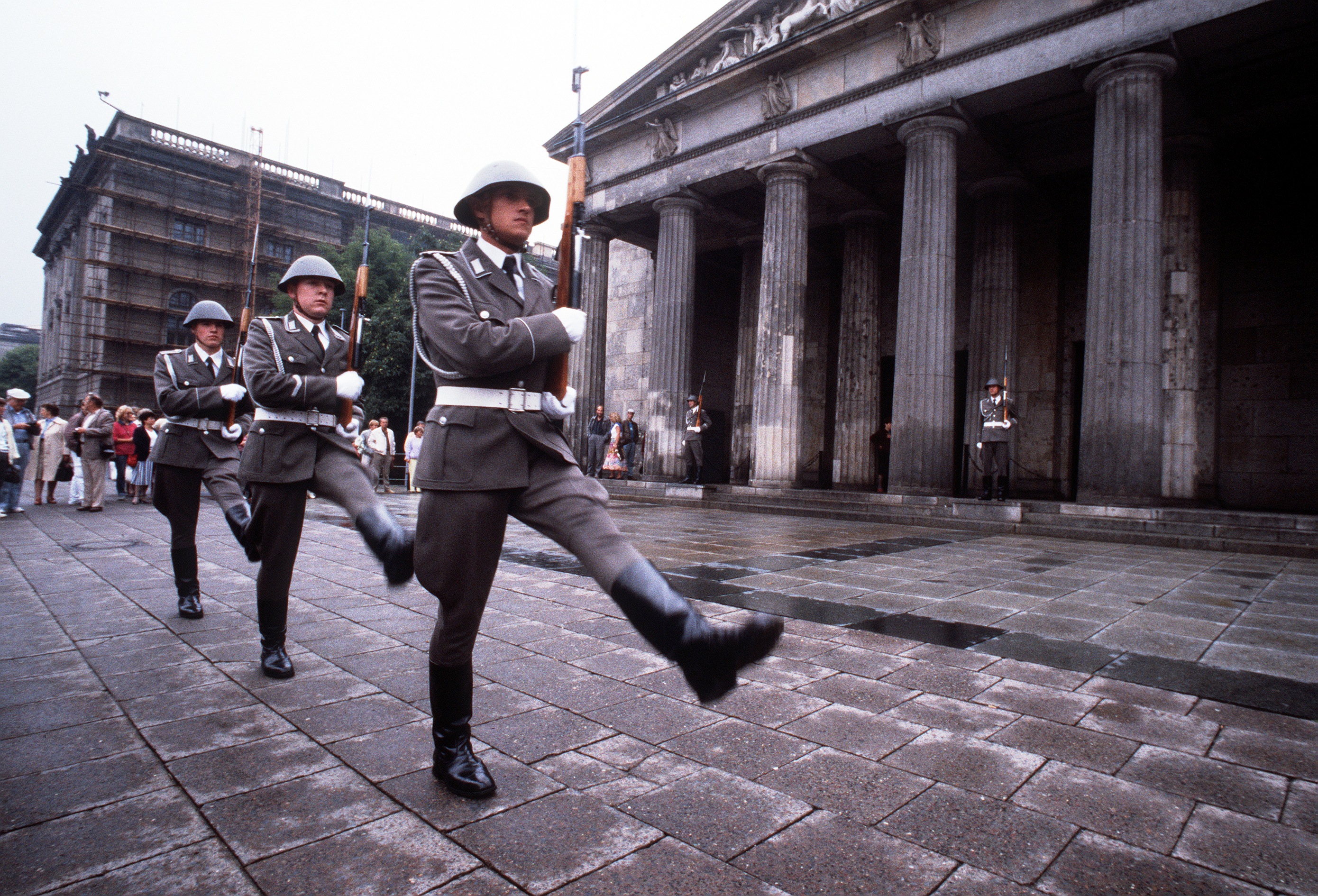
Ironically, by claiming selected Prussian traditions in the NVA and instigating a “Prussia Renaissance" starting in the late 1970s, it was the GDR itself that made the separation of German historical tradition and Marxism-Leninism much easier to discern. While officially condemning Prussian militarism, the GDR made concerted efforts to reintroduce past military traditions and rehabilitate certain historical figures. These include individuals such as Gerhard von Scharnhorst, a military reformer of the Prussian forces during the Napoleonic Wars for whom the highest military award in the GDR, the Scharnhorst Order, was created in 1966. The NVA further retained the Stechschritt (“goose step”) marching and Wehrmacht-style uniform elements to distinguish itself from what the GDR portrayed as the “Americanized” Bundeswehr.[26] The GDR therefore demonstrated that such traditions could be separated from the regimes that previously produced them and instead assigned new ideological meanings. Such choices would have an impact during the transformation of GDR memories after 1990. Thirty-six years later, a major political party is now seeking to restore a form of public recognition to members of that institution. For example, an AfD member of the parliament (Bundestag), Hannes Gnauck, argued for the recognition of the service of certain former personnel of the NVA during debates in the 2026 National Veterans Day. Earlier on June 9th, 2026, the parliamentary group representing the AfD introduced motion 21/6357, which calls for the state to consider former conscripted NVA personnel as legitimate military veterans if they did not participate in unlawful acts or repression.[27] Such examples highlight the engagement of the AfD with unresolved status and memory in the former GDR as a rehabilitation of parts of a once “traditional” Germany. It is therefore remarkable that Björn Höcke, the current co-speaker of the AfD’s Thuringia state association and leader of the parliamentary group in the Thuringian Landtag, told an audience of the youth wing (Junge Alternative) in Dresden in 2017 that he wants them “as new Prussians”, subsequently praising “Prussian virtues” as something from which the rest of Germans could benefit.[28]
Source: U.S. Department of Defense, VIRIN DF-ST-89-04331, via Wikimedia Commons.
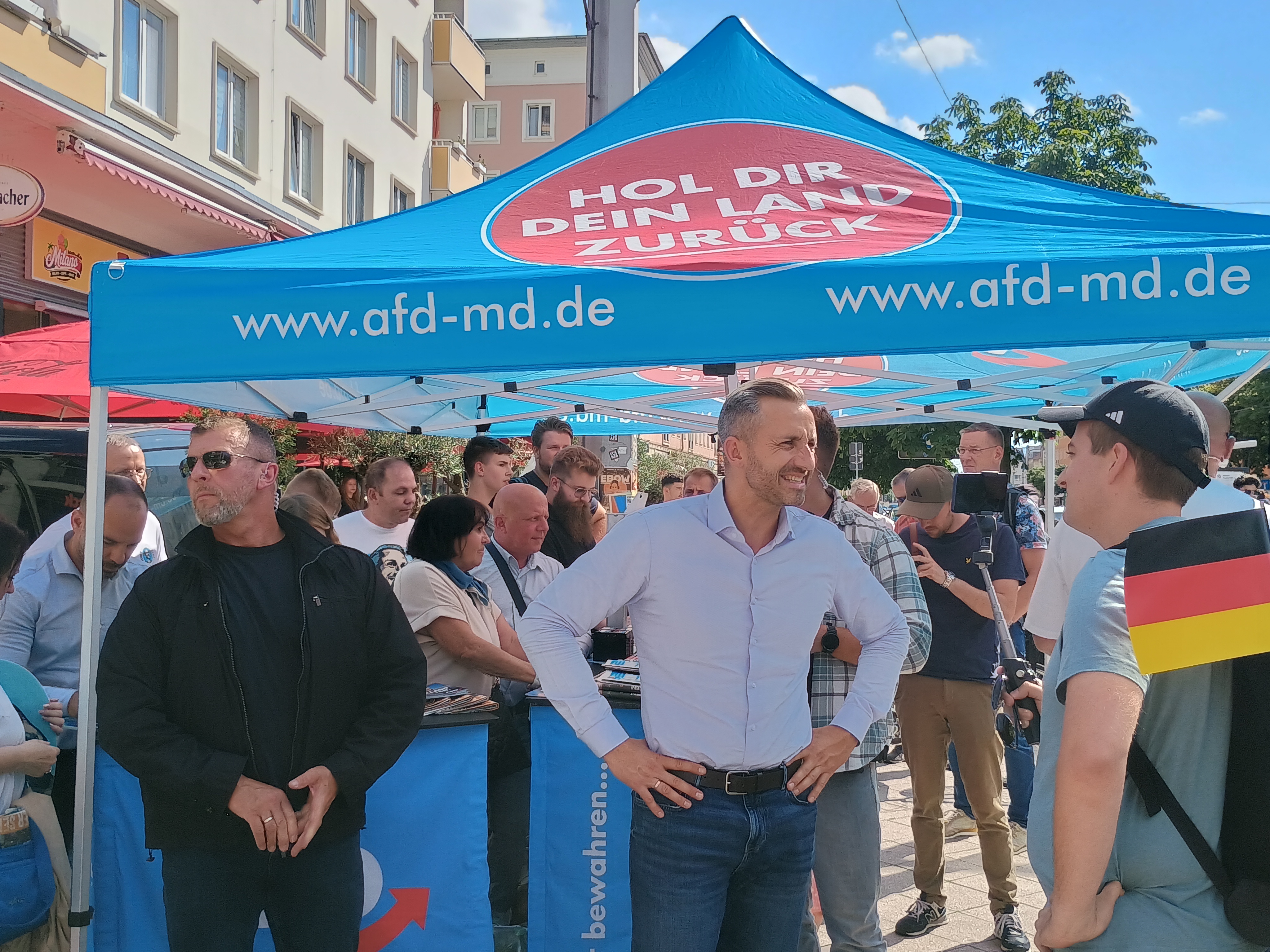
Founded in 2013, the Alternative für Deutschland did not begin as a movement based on nostalgia for the GDR. The party was initially characterized as Eurosceptic and liberal-conservative, but its breakthroughs in Saxony, Thuringia and Brandenburg in 2014 galvanized the national-conservative and right-populist elements that wanted to move beyond the Eurocritical core of the movement. An internal struggle led to the replacement of leadership in July of 2015 and the departure of much of the economic-liberal wing.[29] Over time and particularly after 2015, migration became an important issue to the party and one of its defining platforms, for the eastern states of Germany were ripe for nativist politics where political alienation and cultural resentment were more pronounced. By 2019, the AfD was actively building an eastern political identity. It was not uncommon to see slogans such as “Wende 2.0” and Der Osten steht auf (“The East Rises Up”) during the 2019 elections in certain eastern regions, with the party appropriating the symbolism of the 1989 peaceful revolution and converting these concepts into points for regional mobilization. As such, the AfD can celebrate East German resistance against repression while fueling grievances against what occurred after the end of the GDR in parallel. Recent scholarship has also shown that Ostalgie has increasingly become a subject of far-right memory politics, with some of the discourse portraying parts of the GDR as akin to that of a lost lifeworld and a point of resistance against traditional western liberal democracy.[30] How was the AfD able to integrate positive memories of the GDR within its anti-communist stance?
At the end of 1989, the GDR was significantly more demographically homogenous than the Federal Republic of Germany, with approximately 1.2% of the population being foreign nationals in the former and 7.7% in the latter. While foreign labor did exist, the GDR generally did not pursue permanent immigration or integration as a policy despite promulgating the idea of socialist internationalism and “friendship of the peoples” as was common in the rest of the Second World. Those who did immigrate, such as contract workers from the Socialist Republic of Vietnam, were often limited to a maximum stay of five years and did not receive full language instruction.[31] These policies make the later nationalist nostalgia entirely plausible as selective memory, given that an individual can remember low immigration rates and demographic homogeneity while ignoring or omitting the official policy of internationalism. These trends align with what Julian Göpffarth would later describe as “multidirectional nostalgia”, where two distinct forms of thought exist in current far-right circles: one regarding positive memories of an idealized past and one regarding resistance to socialism rather than admiration for the system. These two forms are not in conflict with one another; their union allows for far-right political memory to resonate with existing individual memories in eastern Germany.[32] By 2026, this appropriation has extended within the AfD to a peculiar state of “cultural nostalgia” that is carefully constructed around the GDR. The Sachsen-Anhalt lead candidate for the AfD, Ulrich Siegmund, who led a landslide victory in the recent Saxony-Anhalt Landtag election, was reportedly seen riding GDR-brand mopeds, speaking repeatedly about wanting an “old, safe Germany” back and joining an event where Auferstanden aus Ruinen was sung.[33] Though likely unthinkable to policymakers in the GDR, their legacy has now become one of the AfD’s elements in its eastern appeal in manners that would otherwise be unconventional for a party that has prided itself in defending traditional German interests against socialist ideology. Ultimately, through an approach of portraying itself as a defender of eastern interests in Germany, the party has been able to convert this political memory into a stark and useful contrast between the “western” and “eastern” Germans and the latter’s status as the “more authentic” Germans.[34]
How did this socialist state become attractive to the AfD? The GDR may have disappeared as a state and its repressive past condemned. Yet, what the state left behind has now been revived in a manner that has maintained an invisible yet tangible division that was once deemed to have been settled. Security soon became order. Social cohesion soon became cultural homogeneity. East German identity soon became regional grievance. The social environment with low immigration then became evidence for a supposedly more authentic German society. The 1989 revolt became anti-establishment legitimacy. The invocation of the GDR only becomes contradictory if memory were to somehow be expected to preserve the ideological coherence of the original system, which has not occurred. The AfD currently propels itself forward with this conviction in mind, collecting fragmented pieces of this past and forging an unlikely hybrid.[35]
In Porto Alegre in 1995, Auferstanden aus Ruinen appeared somewhere where it did not belong. Three decades later, the same anthem of a bygone era appeared somewhere where it has been modified to belong. Whether that anthem may represent only the beginning of what is politically usable regarding the GDR shall remain to be seen.[36]
Sources
[1] taz, contemporaneous report on Federal President Roman Herzog’s November 1995 visit to Porto Alegre and the mistaken performance of the GDR anthem, 25 November 1995, https://taz.de/Den-Sozialismus-in-seinem-Lauf-haelt-weder-Ochs-noch-Esel-auf-Generalsekretaer-Erich-Honecker/!1482911/
[2] German Federal Government, statement on the Volkskammer’s declaration of accession and the October 3rd, 1990 effective date, https://www.bundesregierung.de/breg-de/service/newsletter-und-abos/bulletin/erklaerung-der-bundesregierung-zur-beitrittserklaerung-der-volkskammer-der-ddr-abgegeben-von-bundeskanzler-dr-helmut-kohl-vor-dem-deutschen-bundestag-783898; Federal Foreign Office, Treaty on the Final Settlement with Respect to Germany and the external settlement of German unity, https://www.auswaertiges-amt.de/en/newsroom/news/110525-2-4-weltdokumenterbe-243674
[3] Federal Foreign Office, Treaty on the Final Settlement with Respect to Germany, signed September 12th, 1990, https://www.auswaertiges-amt.de/resource/blob/243466/2851e102b97772a5772e9fdb8a978663/vertragstextoriginal-data.pdf
[4] Bundesarchiv, MfS-Lexikon, “Hauptamtlicher Mitarbeiter,” reporting 91,015 full-time Ministry for State Security employees on October 31st, 1989, https://www.bundesarchiv.de/im-archiv-recherchieren/stasi-unterlagen-einsehen/hinweise-zum-mfs/mfs-lexikon/detail/hauptamtlicher-mitarbeiter/; Bundesarchiv, “Was war die Stasi?”, https://www.bundesarchiv.de/themen-entdecken/online-entdecken/staatssicherheit/was-war-die-stasi/
[5] Bundeszentrale für politische Bildung (bpb), “Die ersten Einheitswahlen zur Volkskammer am 15. Oktober 1950,” on the National Front’s single-list elections and absence of genuine electoral choice, https://www.bpb.de/themen/deutsche-teilung/ddr-kompakt/521483/die-ersten-einheitswahlen-zur-volkskammer-am-15-oktober-1950/
[6] Bundeszentrale für politische Bildung (bpb), “17. Juni 1953,” on the increased work norms, expansion of the uprising and Soviet military intervention, https://www.bpb.de/themen/zeit-kulturgeschichte/deutschland-chronik/131294/17-juni-1953/
[7] Bundeszentrale für politische Bildung (bpb), “Die DDR in den siebziger Jahren,” reporting that the GDR attained the highest living standard among COMECON states between 1970 and 1980, https://www.bpb.de/shop/zeitschriften/izpb/zeiten-des-wandels-258/10111/die-ddr-in-den-siebziger-jahren/
[8] Bundeszentrale für politische Bildung (bpb), “Die DDR in den siebziger Jahren,” for GDR household ownership of cars, refrigerators, televisions and washing machines, https://www.bpb.de/shop/zeitschriften/izpb/zeiten-des-wandels-258/10111/die-ddr-in-den-siebziger-jahren/; William J. Tompson, The Soviet Union under Brezhnev (Longman/Routledge, 2003), pp. 83–85, for comparative Soviet household ownership of durable consumer goods, https://www.routledge.com/The-Soviet-Union-under-Brezhnev/Tompson/p/book/9780582327191
[9] Bundeszentrale für politische Bildung (bpb), “Geschichte der Migration nach und aus Deutschland,” on at least 2.7 million people leaving the GDR before construction of the Berlin Wall, disproportionately young and qualified, https://www.bpb.de/themen/migration-integration/regionalprofile/deutschland/341068/geschichte-der-migration-nach-und-aus-deutschland/; bpb, “Die DDR in den siebziger Jahren,” on consumer shortages and long waiting periods, https://www.bpb.de/shop/zeitschriften/izpb/zeiten-des-wandels-258/10111/die-ddr-in-den-siebziger-jahren/
[10] Steffen Mau, Thomas Lux and Julian Heide, “Der lange Schatten der DDR? Zum Zusammenhang von ehemaliger Systemnähe und aktuellen politischen Orientierungen von Ostdeutschen,” Zeitschrift für Soziologie 55, no. 2 (2026): 117–134, DOI 10.1515/zfsoz-2026-3003; DIW Berlin summary, https://www.diw-berlin.de/de/diw_01.c.1013243.de/s_16184.html
[11] Till Hilmar, “Fragile Bonds of Recognition: Exploring the Social Underpinnings of Sentiments of Exclusion in Post-1989 East Germany,” European Journal of Sociology 63, no. 2 (2022): 247–278, DOI 10.1017/S0003975622000236, https://www.cambridge.org/core/journals/european-journal-of-sociology-archives-europeennes-de-sociologie/article/fragile-bonds-of-recognition-exploring-the-social-underpinnings-of-sentiments-of-exclusion-in-post1989-east-germany/F168411C16EDA7B8B7B3DAFD33505927; Christian Rau, “Ambivalent Entanglements and Participations: New Research on the History of Subjectivities and Identities in East Germany,” Contemporary European History 35 (2026), e58, DOI 10.1017/S096077732610157X, https://www.cambridge.org/core/journals/contemporary-european-history/article/ambivalent-entanglements-and-participations-new-research-on-the-history-of-subjectivities-and-identities-in-east-germany/BD1C0F083D94644BBB426EA1AB63081E
[12] Bundeszentrale für politische Bildung (bpb), “Wirtschafts- und Sozialpolitik,” on Honecker’s Einheit von Wirtschafts- und Sozialpolitik, pensions, maternity provisions, childcare, housing and the debt/investment tradeoff, https://www.bpb.de/themen/deutsche-teilung/ddr-kompakt/521894/wirtschafts-und-sozialpolitik/
[13] Bundeszentrale für politische Bildung (bpb), “Die Einrichtungen des Gesundheits- und Sozialwesens in der DDR und in den neuen Bundesländern,” reporting approximately 94% kindergarten provision in 1988, https://www.bpb.de/shop/zeitschriften/apuz/archiv/536807/die-einrichtungen-des-gesundheits-und-sozialwesens-in-der-ddr-und-in-den-neuen-bundeslaendern/; bpb, “Der Schein der Normalität 1971 bis 1982,” for heavily subsidized rents and household living standards, https://www.bpb.de/shop/zeitschriften/izpb/geschichte-der-ddr-312/48547/der-schein-der-normalitaet-1971-bis-1982/
[14] Bundeszentrale für politische Bildung (bpb), “Der Schein der Normalität 1971 bis 1982,” on FDJ membership, institutional pressure and organized leisure activities, https://www.bpb.de/shop/zeitschriften/izpb/geschichte-der-ddr-312/48547/der-schein-der-normalitaet-1971-bis-1982/
[15] Pamela Heß, “Mehr Gemeinschaftsgefühl und ein stärkerer sozialer Zusammenhalt? Erinnerungen an die DDR als Potenzial für Generationenkonflikte,” Deutschland Archiv, bpb, https://www.bpb.de/themen/deutschlandarchiv/203625/mehr-gemeinschaftsgefuehl-und-ein-staerkerer-sozialer-zusammenhalt-erinnerungen-an-die-ddr-als-potenzial-fuer-generationenkonflikte/; bpb, “Ostdeutsche Identitäten,” https://www.bpb.de/themen/deutschlandarchiv/308016/ostdeutsche-identitaeten/?tab=2
[16] German Federal Government, “Vorläufer der Treuhandanstalt entsteht,” on the March 1990 precursor, the June 17th Treuhand Law and its July 1st entry into force, https://www.bundesregierung.de/breg-de/schwerpunkte/deutsche-einheit/vorlaeufer-der-treuhandanstalt-entsteht-406346
[17] Bundeszentrale für politische Bildung (bpb), “Die Geburtsstunde der Treuhand,” reporting roughly 4.1 million employees initially, about 1.5 million jobs remaining in privatized successor enterprises, more than 3,700 closures and about 7,600 enterprises threatened with acute insolvency after monetary union, https://www.bpb.de/kurz-knapp/hintergrund-aktuell/201919/die-geburtsstunde-der-treuhand/
[18] Kim Leonie Kellermann, “Trust we lost: The impact of the Treuhand experience on political alienation in East Germany,” Journal of Comparative Economics 52, no. 1 (2024): 54–75, DOI 10.1016/j.jce.2023.10.001, https://www.sciencedirect.com/science/article/pii/S014759672300094X. The article reports lower trust, lower political interest, weaker identification with mainstream democratic parties and greater radical-party preference, with effects persisting for up to 30 years. It also reports stronger alienation effects among respondents who had been happy with the GDR social system.
[19] Till Hilmar, “Fragile Bonds of Recognition,” European Journal of Sociology 63, no. 2 (2022): 247–278, DOI 10.1017/S0003975622000236, https://www.cambridge.org/core/journals/european-journal-of-sociology-archives-europeennes-de-sociologie/article/fragile-bonds-of-recognition-exploring-the-social-underpinnings-of-sentiments-of-exclusion-in-post1989-east-germany/F168411C16EDA7B8B7B3DAFD33505927; Sächsische Staatsregierung, Sachsen-Monitor 2023, https://www.staatsregierung.sachsen.de/sachsen-monitor-2023-8897.html
[20] Sächsische Staatsregierung, Sachsen-Monitor 2023, representative survey of 2,041 adults in Saxony, reporting 60% agreement that East Germans were treated as second-class citizens, 86% pride in what Saxony had achieved since 1990 and 60% agreement that the GDR had been an Unrechtsstaat, https://www.staatsregierung.sachsen.de/sachsen-monitor-2023-8897.html
[21] Bundeszentrale für politische Bildung (bpb), “Der lange Weg zur inneren Einheit: Ergebnisse der Sächsischen Längsschnittstudie,” reporting that across survey waves from 2000 to 2012 between 80% and 92% were glad to have personally experienced the GDR and that support for German reunification rose from 73% in 1990 to 91% in 2013, https://www.bpb.de/themen/deutschlandarchiv/194856/der-lange-weg-zur-inneren-einheit-ergebnisse-der-saechsischen-laengsschnittstudie/
[22] Julian Göpffarth, “Activating the socialist past for a nativist future: far-right intellectuals and the prefigurative power of multidirectional nostalgia in Dresden,” Social Movement Studies 20, no. 1 (2021): 57–74, DOI 10.1080/14742837.2020.1722628, https://www.tandfonline.com/doi/full/10.1080/14742837.2020.1722628; Christian Rau, “Ambivalent Entanglements and Participations,” Contemporary European History 35 (2026), e58, DOI 10.1017/S096077732610157X, https://www.cambridge.org/core/journals/contemporary-european-history/article/ambivalent-entanglements-and-participations-new-research-on-the-history-of-subjectivities-and-identities-in-east-germany/BD1C0F083D94644BBB426EA1AB63081E
[23] Bundeswehr Center for Military History and Social Sciences, “Armee der Einheit,” on the NVA/Bundeswehr personnel transition, including approximately 26,000 applicants, 18,000 initial two-year appointments and approximately 10,800 former NVA personnel ultimately retained, https://zms.bundeswehr.de/de/mediathek/armee-der-einheit-6091722; German History in Documents and Images, “The First Group of Soldiers from the East German National People’s Army Is Sworn into the Bundeswehr,” https://germanhistorydocs.org/en/a-new-germany-1990-2023/the-first-group-of-soldiers-from-the-east-german-national-people-s-army-is-sworn-into-the-bundeswehr-october-19-1990
[24] Bundeswehr, “Integration der Nationalen Volksarmee in die Bundeswehr,” on rank reductions, NCO career tracks and the documented case of an NVA lieutenant becoming a Bundeswehr Feldwebel, described as a Karriereknick, https://www.bundeswehr.de/de/organisation/luftwaffe/aktuelles/integration-der-nationalen-volksarmee-in-die-bundeswehr-3087306; Bundeswehr, “Auswirkungen für die Soldaten in Ost und West,” on pay equalization for former NVA NCOs in 2007 and officers in 2009, https://www.bundeswehr.de/de/auswirkungen-fuer-die-soldaten-in-ost-und-west-88242
[25] Bundeswehr Center for Military History and Social Sciences, “Historisches Dokument: 35 Jahre Armee der Einheit,” on the 370,000-personnel ceiling following the Two Plus Four settlement, https://zms.bundeswehr.de/de/mediathek/historisches-dokument-35-jahre-armee-der-einheit-5990700; Bundeswehr, historical materials on NVA integration and screening for political functions and MfS involvement, https://www.bundeswehr.de/de/selbstverstaendnis/geschichte-bundeswehr/armee-der-einheit-wiedervereinigung
[26] Marcus Colla, Prussia in the Historical Culture of the German Democratic Republic: Communists and Kings (Oxford University Press, 2022), DOI 10.1093/oso/9780192865908.001.0001, https://academic.oup.com/book/44037; Bundeszentrale für politische Bildung (bpb), “Preußentum und DDR-Sozialismus,” https://www.bpb.de/shop/zeitschriften/apuz/archiv/532168/preussentum-und-ddr-sozialismus/; Bundeswehr Center for Military History and Social Sciences, “Deutsche Militärgeschichte in Europa,” on the NVA’s selective claim to German military traditions, Stechschritt and Wehrmacht-style appearance in contrast to the portrayed “Americanized” Bundeswehr, https://zms.bundeswehr.de/de/mediathek/deutsche-militaergeschichte-in-europa-5675754
[27] Deutscher Bundestag, Motion 21/6357, “Anerkennung ehemaliger Angehöriger der Nationalen Volksarmee im Rahmen eines gesamtdeutschen Veteranenverständnisses,” June 9th, 2026, https://dserver.bundestag.de/btd/21/063/2106357.pdf; Deutscher Bundestag, “Vereinbarte Debatte zum Nationalen Veteranentag,” June 12th, 2026, summarizing Hannes Gnauck’s argument for possible veteran recognition of qualifying former NVA soldiers, https://www.bundestag.de/dokumente/textarchiv/2026/kw24-de-vereinbarte-debatte-veteranentag-1181966
[28] Thüringer Landtag, official biography of Björn Höcke, listing him as speaker of the AfD Thüringen state association and chair of the AfD parliamentary group, https://www.thueringer-landtag.de/abgeordnete/abgeordnete-fraktionen-sitzordnung/abgeordnetendetails/abgeordneter/bjoern-hoecke/; DIE ZEIT, report and transcript excerpts from Höcke’s January 2017 Dresden speech, including “neue Preußen” and “preußische Tugenden,” https://www.zeit.de/zett/politik/2017-01/keine-satire-das-hat-bjoern-hoecke-tatsaechlich-alles-gesagt
[29] Bundeszentrale für politische Bildung (bpb), “Etappen der Parteigeschichte der AfD,” on the party’s 2013 eurocritical and liberal-conservative beginnings, the importance of its 2014 eastern state-election successes, the July 2015 leadership change and departure of much of the economic-liberal wing, https://www.bpb.de/themen/parteien/parteien-in-deutschland/afd/273130/etappen-der-parteigeschichte-der-afd/; bpb, “Die AfD: Werdegang und Wesensmerkmale einer Rechtsaußenpartei,” https://www.bpb.de/themen/parteien/rechtspopulismus/271484/die-afd-werdegang-und-wesensmerkmale-einer-rechtsaussenpartei/
[30] Bundeszentrale für politische Bildung (bpb), “Umkämpftes Erbe,” on the AfD’s 2019 eastern campaigns using “Wende 2.0,” “Wende vollenden” and “Der Osten steht auf!”, https://www.bpb.de/shop/zeitschriften/apuz/295461/umkaempftes-erbe/; Manuel Menke and Tim Wulf, “The Dark Side of Inspirational Pasts: An Investigation of Nostalgia in Right-Wing Populist Communication,” Media and Communication 9, no. 2 (2021), DOI 10.17645/mac.v9i2.3803, https://www.cogitatiopress.com/mediaandcommunication/article/view/3803; Christian Rau, “Ambivalent Entanglements and Participations,” Contemporary European History 35 (2026), e58, https://www.cambridge.org/core/journals/contemporary-european-history/article/ambivalent-entanglements-and-participations-new-research-on-the-history-of-subjectivities-and-identities-in-east-germany/BD1C0F083D94644BBB426EA1AB63081E
[31] Bundeszentrale für politische Bildung (bpb), “Umgang mit Minderheiten in der DDR,” reporting 191,000 foreign nationals in the GDR at the end of 1989, or 1.2% of the population, compared with 7.7% in the Federal Republic, https://www.bpb.de/themen/deutschlandarchiv/126678/umgang-mit-minderheiten-in-der-ddr/; Vũ Vân Phạm, “Vertragsarbeiterinnen in der DDR: Frauen aus Vietnam im Blick,” Deutschland Archiv, bpb, on the absence of a permanent integration policy, contracts of up to five years and German courses limited to approximately two months of work-related vocabulary, https://www.bpb.de/themen/deutschlandarchiv/548449/vertragsarbeiterinnen-in-der-ddr/
[32] Julian Göpffarth, “Activating the socialist past for a nativist future,” Social Movement Studies 20, no. 1 (2021): 57–74, DOI 10.1080/14742837.2020.1722628, https://www.tandfonline.com/doi/full/10.1080/14742837.2020.1722628. Göpffarth describes the convergence of positive nostalgia and nostalgia for resistance to socialism as “multidirectional nostalgia” and a cultural opportunity structure for far-right electoral success.
[33] WDR/ARD Monitor, “Wahlkampf im Osten: Mit der AfD zurück zur DDR?”, July 30th, 2026, documenting Ulrich Siegmund’s Simson campaign event, rhetoric about an “old, safe Germany” and participation in an AfD event where Auferstanden aus Ruinen was sung, https://www1.wdr.de/daserste/monitor/sendungen/wahlkampf-im-osten-mit-der-afd-zurueck-zur-ddr-100.amp; official preliminary results for the 2026 Sachsen-Anhalt Landtag election, AfD 43.8% of second votes, https://wahlergebnisse.sachsen-anhalt.de/wahlen/lt26/erg_land.html
[34] WDR/ARD Monitor, “Wahlkampf im Osten: Mit der AfD zurück zur DDR?”, July 30th, 2026, including Björn Höcke’s contrast between western “German-speaking Americans” and eastern “German-speaking Germans” and the report’s analysis of an eastern claim to greater German authenticity, https://www1.wdr.de/daserste/monitor/sendungen/wahlkampf-im-osten-mit-der-afd-zurueck-zur-ddr-100.amp; Christian Rau, “Ambivalent Entanglements and Participations,” Contemporary European History 35 (2026), e58.
[35] Christian Rau, “Ambivalent Entanglements and Participations,” Contemporary European History 35 (2026), e58, on the far-right relocation of Ostalgic memories into political contexts removed from their original socialist meanings; Julian Göpffarth, “Activating the socialist past for a nativist future,” Social Movement Studies 20, no. 1 (2021): 57–74; Manuel Menke and Tim Wulf, “The Dark Side of Inspirational Pasts,” Media and Communication 9, no. 2 (2021); Steffen Kailitz and Susanne Rippl, “Same Seeds, More Fertile Ground: Sources of AfD Dominance in Eastern Germany,” German Politics 35, no. 3 (2026): 437–462, DOI 10.1080/09644008.2026.2682305, https://www.tandfonline.com/doi/full/10.1080/09644008.2026.2682305
[36] taz, contemporaneous report on the mistaken performance of Auferstanden aus Ruinen during Roman Herzog’s Porto Alegre visit in 1995, https://taz.de/Den-Sozialismus-in-seinem-Lauf-haelt-weder-Ochs-noch-Esel-auf-Generalsekretaer-Erich-Honecker/!1482911/; WDR/ARD Monitor, “Wahlkampf im Osten: Mit der AfD zurück zur DDR?”, July 30th, 2026, documenting the anthem’s deliberate appearance at an AfD event, https://www1.wdr.de/daserste/monitor/sendungen/wahlkampf-im-osten-mit-der-afd-zurueck-zur-ddr-100.amp